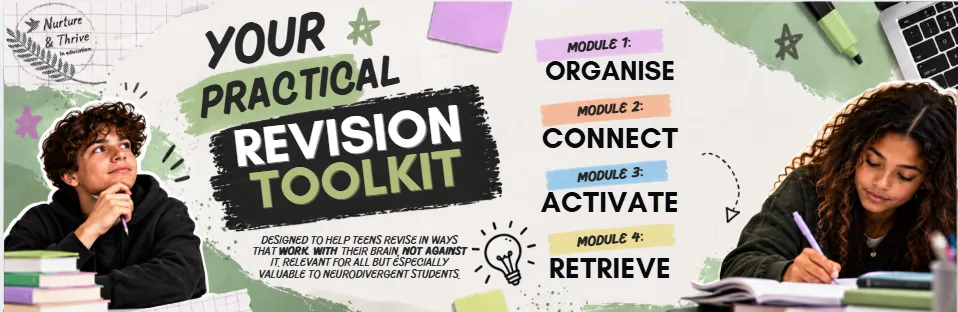
THE PRACTICAL REVISION TOOLKIT
Less staring at notes. More learning that sticks.
12 practical, creative revision techniques to help students discover HOW to revise, not just WHAT to revise.
A fun, accessible, step-by-step video programme with implementation booklet that helps students organise information, make it memorable and practise recalling it when they need it.
Using real examination material, broken down into clear, manageable examples, students learn revision skills they can start using from Year 7 onwards.
Especially valuable for neurodivergent learners, but designed for every student who wants a more varied and effective approach to learning.

Who is this for?
Whether they're just starting secondary school, preparing for their first assessments or working towards GCSEs and A'Levels, this toolkit is particularly useful for students who:
- Don't really know HOW to revise.
- Feel overwhelmed by lots of information.
- Struggle to get started or stay engaged.
- Spend ages making and reading notes but struggle to remember them.
- Find traditional revision methods boring, frustrating or ineffective.
- Would benefit from creative, practical alternatives.
- Need support developing confidence and independence in their learning.
Especially suitable for neurodivergent learners, including those with ADHD, autism or dyslexia, who may benefit from greater variety, structure and flexibility in their approach to learning.
The process
Every revision strategy follows the same simple structure:
1. WATCH IT
See the technique explained clearly, with engaging demonstrations and relatable examples.
2. TRY IT
Follow along using the accompanying workbook, with all the information provided. There's no need to understand the topic beforehand.
3. MAKE IT YOUR OWN
Take what you've learned and practise using the technique with your own schoolwork.
4. FIND WHAT WORKS
Use the revision tracker to reflect on which strategies helped and when you might use them again.
No complicated instructions. No assumed knowledge. No pressure to get everything perfect.
Just practical opportunities to develop skills, experiment and build confidence.

About Charlotte
I'm Charlotte MacDougall, a specialist teacher, dyslexia assessor and neurodivergence specialist with over 15 years' experience in education.
Throughout my teaching career, I've seen so many bright, capable students struggle with revision, not because they can't learn, but because they've never really been taught HOW to learn effectively.
And for neurodivergent students, traditional approaches can create even more barriers, particularly when working memory, attention and executive functioning are involved.
That's why I created The Practical Revision Toolkit.
Drawing on my experience in the classroom and my specialist understanding of how we learn, I've brought together 12 practical, creative revision techniques, demonstrated step by step using real subject material.
My aim is simple: to give young people the tools, confidence and independence to discover what works for their brain, whether they're just starting secondary school or preparing for their GCSEs.
The Modules
MODULE 1: ORGANISE 🟣
Make information easier to manage. When there's a mountain of information to revise, knowing how to organise it can make everything feel more manageable. Discover three practical techniques:
MIND MAPS – When there's lots of information to organise and connect.
TIMELINES – When events, stages or processes need to be remembered in order.
POST & PLACE – When you want to make stubborn facts more memorable using visual reminders.
Learn how to turn overwhelming notes into clear, manageable revision resources.
MODULE 2: CONNECT 🟠
Give your brain more ways back. Memory works through connections. The more meaningful clues we create, the more ways we may have to retrieve information later. Discover three techniques:
MEMORY JOURNEYS – Connect information to familiar places or routes.
MNEMONICS – Turn key words or first letters into memorable cues.
STORIES – Link information together through imaginative stories.
Learn how to make information more meaningful, memorable and easier to recall.
MODULE 3: ACTIVATE 🔵
Do something with the information. Revision doesn't always need to look like revision. Turning information into something new encourages learners to engage with it more actively. Discover three creative techniques:
RHYTHM & RHYME – Make facts stick using familiar tunes, beats and repetition.
RECORD & REPLAY – Strengthen understanding by explaining information in your own words and listening back.
SKETCH & COMIC – Turn information into visual stories, pictures and diagrams.
Learn how to make revision more active, creative and engaging.
MODULE 4: RETRIEVE 🟡
Practise getting the information back out. Here's the really important bit. Recognising information when you see it isn't the same as being able to remember it independently. Testing yourself doesn't just show you what you know. Retrieval practice can actually help strengthen your memory. Discover three techniques:
FLASHCARDS – Test your knowledge of key facts, terms and definitions.
QUESTION & QUIZ – Challenge yourself with factual, explanation and application questions.
TEACH IT BACK – Check your understanding by explaining a topic from memory.
Learn how to test yourself, spot gaps in your knowledge and build more reliable recall.
This isn't a programme where students simply sit and listen to someone talking about revision.
Every technique is demonstrated, then students get to have a go themselves.
Each module includes:
Short teaching videos explaining the techniques and how they work.
Worked examples showing how to transform actual subject information into useful revision resources.
Practical workbook activities so students can immediately experiment with each strategy.
Step-by-step instructions they can return to whenever they want to use a technique independently.
A revision strategy tracker to help identify which approaches work best for them.
What's included?
THE COMPLETE PRACTICAL REVISION TOOLKIT
-4 step-by-step student video modules.
-12 practical revision techniques.
-Worked examples using exam style material
-Downloadable activity workbooks to try each technique.
-Revision strategy trackers and reflection activities.
A comprehensive and practical toolkit your child(ren) can return to throughout their revision journey.
The Value
An investment in HOW your child learns, not just WHAT they learn.
Inside The Practical Revision Toolkit, your child will discover 12 practical techniques across four video modules, with worked examples, downloadable workbooks and supporting resources.
Each technique is a valuable skill in its own right. Together, they create a toolkit students can return to again and again, whether they're preparing for their first secondary school assessments, revising for GCSEs or moving on to further study.
And unlike subject-specific revision resources, these strategies can be used across different subjects, topics and exams.
The complete Practical Revision Toolkit: £150
One investment. 12 techniques. Skills they can use for years to come.
A few things you might be wondering...
My child already knows how to make mind maps and flashcards. Will they learn anything new?
Knowing what a revision technique is and knowing how to use it effectively are two different things! This programme goes beyond introducing the techniques. Students learn when to choose each one, how to apply it to real information and, importantly, how to check whether it's actually helping them learn.
What if my child doesn't enjoy some of the activities?
That's absolutely fine! In fact, that's part of the point. There isn't one perfect revision strategy for everyone. The aim is to experiment with different approaches and build a toolkit of techniques that suit different subjects, situations and individual preferences.
Will this actually help my child become more independent with revision?
That's certainly the goal. Rather than relying on parents or teachers to tell them how to revise, students learn practical methods they can choose and use themselves. Independence takes practice, particularly for students with executive functioning difficulties, but this gives them a starting point.
How long will my child have access?
Lifetime access. The toolkit is designed to be revisited as students progress through secondary school, so they can return to individual techniques whenever they need them.
Copyright 2026 Nurture & Thrive | Privacy Policy


